

In early-stage pharmaceutical formulation development, teams are under pressure to move fast. APIs are still evolving, stability data is limited, and timelines are tight. In that context, capsules are often treated as a “later” decision, something to optimize once the formulation is locked.
In practice, capsule choices made too late can slow down drug development, increase regulatory friction, or force unnecessary reformulation. We examine the most common blind spots teams encounter, and how addressing critical decisions earlier can reduce risk and preserve momentum.
Why Choosing the Right Capsule is Important
At the preclinical and early clinical stages, capsules are more than a container. They influence:
- API stability and compatibility
- Filling performance and batch consistency
- Regulatory continuity from clinical to commercial stages
- Supply reliability as programs scale
Ignoring these variables early often leads to avoidable rework later.
Blind Spot #1: Assuming “Any Capsule Will Do” in Early Development
Many teams default to standard capsules during early trials, assuming capsule choice has little impact as long as the API performs. This becomes an issue when:
- APIs are hygroscopic or moisture-sensitive
- Fill materials evolve during development
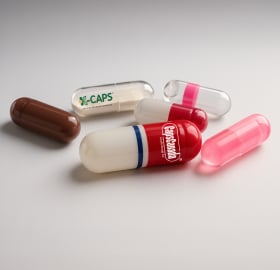
This is where Lyfe Group’s FM-CAPS® clinical trial capsules come into play. Developed to support preclinical and clinical stages, FM-CAPS® are designed to streamline capsule development and testing by integrating a broad range of dyes and additives into a single capsule, allowing teams to refine color and presentation later, without reformulation or resubmission delays caused by colorant changes.
Blind Spot #2: Underestimating Capsule Material Impact on the API
Key differences between gelatin and HPMC capsules, ranging from moisture content to formulation compatibility, can have a measurable impact on API performance early in development.
G-CAPS® (Gelatin Capsules)
- Made from 100% bovine hide gelatin
- Fast and predictable disintegration
- Vertically integrated supply chain (gelatin only)
- Well-suited for a wide range of pharmaceutical applications
K-CAPS® (HPMC Capsules)
- Plant-derived, HPMC-based capsules
- Lower moisture content (ideal for sensitive or hygroscopic APIs)
- Broad compatibility with powders, liquids, gels, and pastes
Blind Spot #3: Treating Supply Chain as a “Future” Problem
Early-stage programs often rely on limited quantities, making supply chain considerations feel premature. However, disruptions can delay trials or commercial launch.
Lyfe Group manufactures capsules in the Americas, with more than 40 years of operational experience. This regional footprint supports:
- Faster lead times for development and clinical batches
- Warehouses across the Americas and worldwide distribution
- Consistent inventory availability
- Easier coordination across North, Central, and South America
For teams planning global expansion, proximity to major logistics routes, including access to the Atlantic and Pacific, adds resilience from day one.
Blind Spot #4: Not Thinking About Commercial Continuity
A frequent mistake in drug development is optimizing capsules only for early trials, then switching formats later. This can trigger:
- Additional stability studies
- New regulatory interactions
- Delays in scale-up
Capsule strategies that support seamless clinical-to-commercial continuity reduce these risks. Selecting capsules that can remain consistent across stages, sizes, materials, and performance helps preserve data integrity and timelines.
Blind Spot #5: Viewing Capsule Suppliers as just Vendors, Not Advisors
Capsules sit at the intersection of formulation science, manufacturing, and regulation. Treating capsule selection as a transactional purchase often means missing technical insights that could prevent downstream issues.
An experienced capsule partner can help teams anticipate challenges related to:
- API-capsule compatibility
- Dosage
- Filling performance across scales
- Moisture and environmental sensitivity
- Long-term supply planning
This advisory role becomes especially valuable when formulations evolve, as they almost always do in early development.
Thinking Ahead Pays Off
In pharmaceutical formulation development, small early decisions can have outsized consequences. Capsules are one of those decisions.
By addressing capsule strategy earlier, through material choice, clinical flexibility, and supply chain alignment, teams can move faster with fewer surprises.
Let’s Talk About Your Development Strategy
If you’re navigating early-stage drug development and want to reduce risk while maintaining speed, our technical team can help you evaluate capsule options aligned with your formulation goals.
Contact an expert to discuss your project.
As part of Lyfe Group, CapsCanada benefits from a broader life sciences network dedicated to supporting innovation across pharmaceuticals and nutraceuticals as well as the health research... This alignment enhances our ability to guide early development decisions with technical insight and long-term supply confidence.